
Nigeria's financial system is at an inflection point. With over 38 million unbanked adults and a fintech sector growing faster than its infrastructure can support, the gap between financial data availability and financial intelligence has never been more consequential. The answer to closing that gap may lie somewhere most people overlook: data labeling.
Targeted Financial Products for Underserved Populations
Labeled data helps financial institutions move beyond one-size-fits-all product design. When transaction data is accurately categorized and annotated, banks and fintechs can understand customer behavior at a granular level — distinguishing between a salaried employee, a market trader, and a gig worker from the same raw data stream.
This intelligence enables the creation of tailored financial products for underserved populations: micro-entrepreneurs operating in informal markets, low-income individuals with irregular income flows, and rural customers with thin credit files. Without labeled data, these segments remain invisible. With it, they become addressable.
Without labeled data, underserved populations remain invisible to financial institutions. With it, they become the most valuable segment to build for.
Regulatory Compliance as a Driver of Inclusion
Accurate data labeling isn't just a product advantage — it's a compliance foundation. Nigeria's CBN Open Banking Framework, the NDPA, and the Consumer Protection Framework all demand that financial institutions demonstrate a clear and auditable understanding of customer data.
When labeling is precise and consistent, institutions can meet these regulatory requirements more efficiently — reducing the cost and complexity of compliance. Lower compliance barriers mean more room for new players to enter the market, which drives competition, innovation, and ultimately, broader financial access.
Enhanced Credit Scoring Through Transaction Intelligence
The most direct link between data labeling and inclusion is credit. Nigeria's credit infrastructure has historically excluded anyone without a formal employment history or collateral — which is the majority of the population.
Accurate labeling of transaction data powers alternative credit scoring models that assess creditworthiness from behavioral signals: spending patterns, merchant category flows, income regularity, and repayment proxies. This enables more people to access loans and financial services based on how they actually transact — not just what they formally declare.
Fraud Detection and Prevention
Financial inclusion only works if people trust the system. High-quality labeled data directly improves the performance of machine learning models trained to detect and prevent fraudulent activity. This is where the architecture of the underlying models becomes critical.
CNNs vs RNNs in Financial Intelligence
- CNNs (Convolutional Neural Networks) analyze transaction patterns spatially — detecting anomalies in how transactions cluster across merchants, amounts, and timeframes in real time.
- RNNs (Recurrent Neural Networks) are designed for sequential data. They have a form of memory that captures context from previous inputs, making them purpose-built for time-series financial data like transaction histories.
- Together: CNNs flag suspicious patterns in real time while RNNs model longitudinal behavior that distinguishes a genuine customer from a fraudster.
| Model Type | Strength | Finance Application |
|---|---|---|
| RNN | Sequential memory, time-series modeling | Credit risk scoring, transaction history analysis, time series forecasting |
| CNN | Pattern recognition across data clusters | Real-time fraud detection, anomaly identification across merchant patterns |
| RNN + CNN | Temporal + spatial intelligence combined | Full-spectrum financial behavior modeling for inclusion and risk |
RNNs are also uniquely powerful for enabling multilingual, voice-first banking interfaces — a critical unlock for non-literate or low-literacy users who represent a significant portion of Nigeria's unbanked population.
The Infrastructure Bet Nobody Is Making
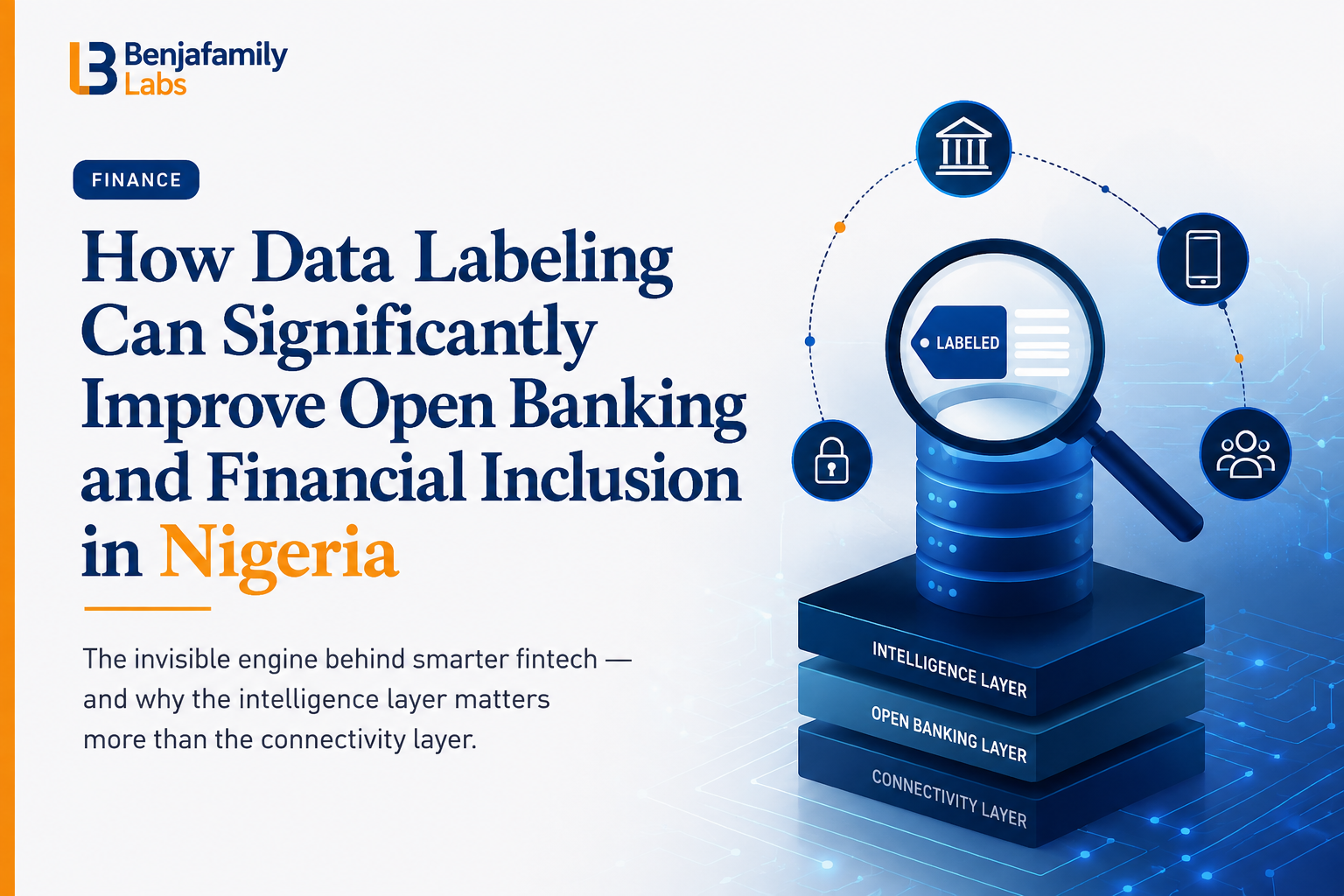
Most open banking conversations in Nigeria focus on connectivity — getting data to flow between institutions. Fewer focus on what happens to that data once it arrives. Data labeling is the unglamorous, high-leverage layer that sits between raw transaction feeds and real financial intelligence.
Getting it right doesn't just improve model performance. It changes who gets a loan, who gets flagged as fraud, and who gets a financial product built for their actual life.
Data labeling is not a technical problem. It is an inclusion problem — and it may be one of the most practical solutions we have.
The institutions — and infrastructure builders — who invest in this layer now will define the intelligence architecture of African fintech for the next decade.