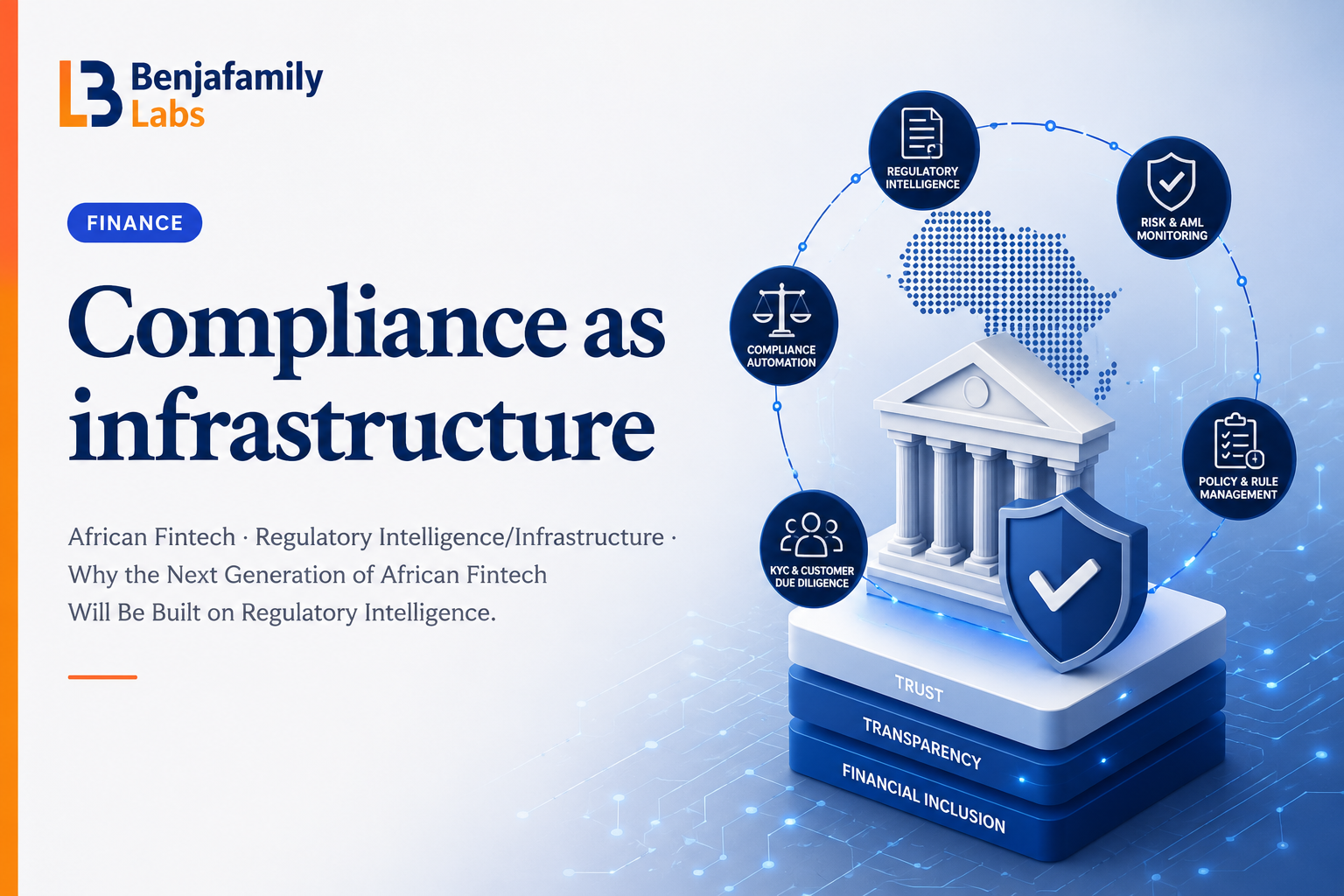
For decades, compliance was treated as administrative overhead — a legal necessity sitting at the margins of financial systems. It was reactive, document-heavy, expensive, and disconnected from product innovation. That paradigm is collapsing. In the modern digital economy, compliance is evolving into infrastructure.
Just as APIs transformed payments into programmable services, regulatory intelligence is transforming compliance into an embedded operational layer powering financial trust, interoperability, and scalable innovation. The future of fintech in Africa will not be defined solely by payment rails, wallets, or lending applications. It will be defined by how intelligently institutions can operationalize trust at scale.
This is the emergence of Compliance-as-Infrastructure (CaaI) — an architecture where regulation, identity verification, transaction monitoring, fraud intelligence, and policy enforcement become programmable systems integrated directly into financial products.
The institutions that understand this transition early will dominate the next decade of African financial services.
The Structural Shift: From Compliance Departments to Compliance Engines
Traditional compliance systems were designed for analog banking environments — manual KYC verification, human-driven reporting, periodic audits, fragmented regulatory checks, static risk models, and siloed monitoring systems. These systems fail in digital financial ecosystems where transactions occur in milliseconds across multiple jurisdictions and channels simultaneously.
Modern fintech infrastructure requires something fundamentally different:
- Real-time transaction intelligence
- Automated AML monitoring
- Embedded sanctions screening
- Adaptive fraud detection
- Behavioral analytics
- Regulatory reporting automation
- Risk orchestration across APIs
- Continuous compliance monitoring
Compliance can no longer operate after transactions occur. It must operate inside the transaction layer itself. This changes compliance from a governance activity into a computational system.
Why Africa Needs Compliance Infrastructure More Than Any Other Region
1. Rapid Digital Financial Expansion
The continent is experiencing accelerated fintech growth across mobile money, agency banking, cross-border payments, digital lending, embedded finance, crypto exposure, and informal economy digitization. But infrastructure growth without regulatory intelligence creates systemic vulnerabilities. Fraud scales. Identity abuse scales. Synthetic accounts scale. Cross-border laundering risks scale. As transaction velocity increases, regulatory systems must become machine-operable.
2. Fragmented Regulatory Environments
African fintech companies operate across multiple jurisdictions with differing frameworks — central bank regulations, AML/CFT obligations, data localization laws, KYC requirements, consumer protection mandates, and payment licensing structures. Without compliance infrastructure, expansion becomes operationally expensive and legally risky. Compliance APIs and middleware systems create standardization layers that reduce friction between regulation and innovation. This is where programmable compliance becomes economically strategic.
3. FATF Greylist Pressure and International Trust Deficits
Several African economies continue facing enhanced FATF scrutiny, with severe consequences: higher correspondent banking risk, reduced international trust, increased monitoring burdens, capital access limitations, and higher remittance friction. Compliance infrastructure addresses this by improving transaction transparency, risk intelligence, suspicious activity detection, beneficial ownership analysis, and real-time auditability.
"Regulatory intelligence becomes financial diplomacy."Compliance Infrastructure Is the New Trust Layer
The internet was built on protocols. Modern finance is now being rebuilt on trust protocols. Every financial ecosystem ultimately depends on confidence — can identities be verified? Can fraud be detected? Can transactions be monitored? Can risks be scored? Can regulators audit activity? Can institutions trust counterparties?
Compliance infrastructure answers these questions computationally. This transforms trust from a legal abstraction into an engineering capability. The most valuable fintech infrastructure companies of the future may not be consumer apps. They may be invisible compliance intelligence networks powering the entire ecosystem underneath.
The Rise of Compliance Middleware
Compliance middleware sits between financial institutions, regulators, payment processors, fintech applications, identity systems, and banking APIs — orchestrating regulatory intelligence across all of them. This infrastructure model mirrors how cloud computing transformed IT. Compliance is becoming composable.
Identity Intelligence
- KYC verification
- Identity graphing
- Biometric validation
- Device fingerprinting
- Behavioral identity analytics
Transaction Intelligence
- AML monitoring
- Pattern detection
- Velocity analysis
- Cross-border anomaly detection
- Sanctions screening
Regulatory Intelligence
- Automated reporting
- Policy mapping
- Risk scoring
- Audit trails
- Regulatory rule engines
Fraud Intelligence
- Synthetic identity detection
- Behavioral fraud analytics
- Mule account detection
- Network risk analysis
Why Compliance-as-Infrastructure Creates Economic Value
One of the biggest misconceptions in fintech is viewing compliance solely as a cost center. In reality, intelligent compliance infrastructure generates economic value across multiple dimensions.
Reduced Operational Costs
- Manual review overhead eliminated
- Investigation delays shortened
- Reporting inefficiencies removed
- Audit preparation automated
Faster Market Expansion
- Multi-country scalability
- Faster licensing adaptation
- Standardized onboarding
- Cross-border interoperability
Improved Lending Intelligence
- Behavioral pattern analysis
- Transaction consistency scoring
- Identity confidence signals
- Stronger underwriting models
Increased Institutional Trust
- Investor confidence signals
- Regulator confidence signals
- Enterprise partnership readiness
- Correspondent bank credibility
The Infrastructure Opportunity for African Startups
Most African fintech innovation still concentrates on consumer-facing products — wallets, transfers, POS systems, lending apps. Yet the deeper opportunity exists beneath the interface layer. Africa needs infrastructure companies building compliance APIs, AML intelligence engines, regulatory orchestration systems, financial risk intelligence platforms, fraud detection infrastructure, behavioral analytics systems, digital identity verification layers, and transaction monitoring architectures.
This sector remains underbuilt relative to the scale of future demand. As regulation intensifies globally, infrastructure providers enabling compliance automation may become foundational ecosystem players.
Artificial Intelligence and the Future of Regulatory Intelligence
AI will significantly reshape compliance infrastructure over the next decade. Future systems will increasingly perform real-time anomaly detection, behavioral transaction analysis, predictive fraud intelligence, dynamic risk scoring, regulatory pattern discovery, automated suspicious activity reporting, and continuous compliance monitoring.
However, AI alone is insufficient. Without high-quality infrastructure, AI becomes unreliable. The future belongs to institutions combining data infrastructure, regulatory architecture, machine intelligence, and trust engineering — not any one of these in isolation.
The Strategic Reality: Compliance Determines Scalability
Historically, startups asked: "How do we acquire users?" The next generation must also ask: "How do we scale trust?" Because in financial systems, distribution scales growth — but compliance scales legitimacy.
The institutions capable of embedding regulatory intelligence directly into their infrastructure will scale faster, partner more easily, raise capital more efficiently, and survive regulatory scrutiny more effectively. Compliance is no longer the cost of growth. It is becoming the architecture of growth itself.
Conclusion: The Future Financial Stack Will Be Regulatory-Native
Africa's digital economy is entering a new infrastructure era. The first wave focused on access. The second wave focused on payments. The next wave will focus on trust automation.
In this environment, compliance evolves from paperwork into programmable infrastructure. The winners of the next decade will not merely build fintech products. They will build trust systems, intelligence layers, regulatory middleware, and compliance infrastructure capable of powering financial ecosystems at continental scale.
Because ultimately, modern finance is not only about moving money. It is about operationalizing trust through infrastructure.
Leave a comment
Your email address will not be published. Required fields are marked *