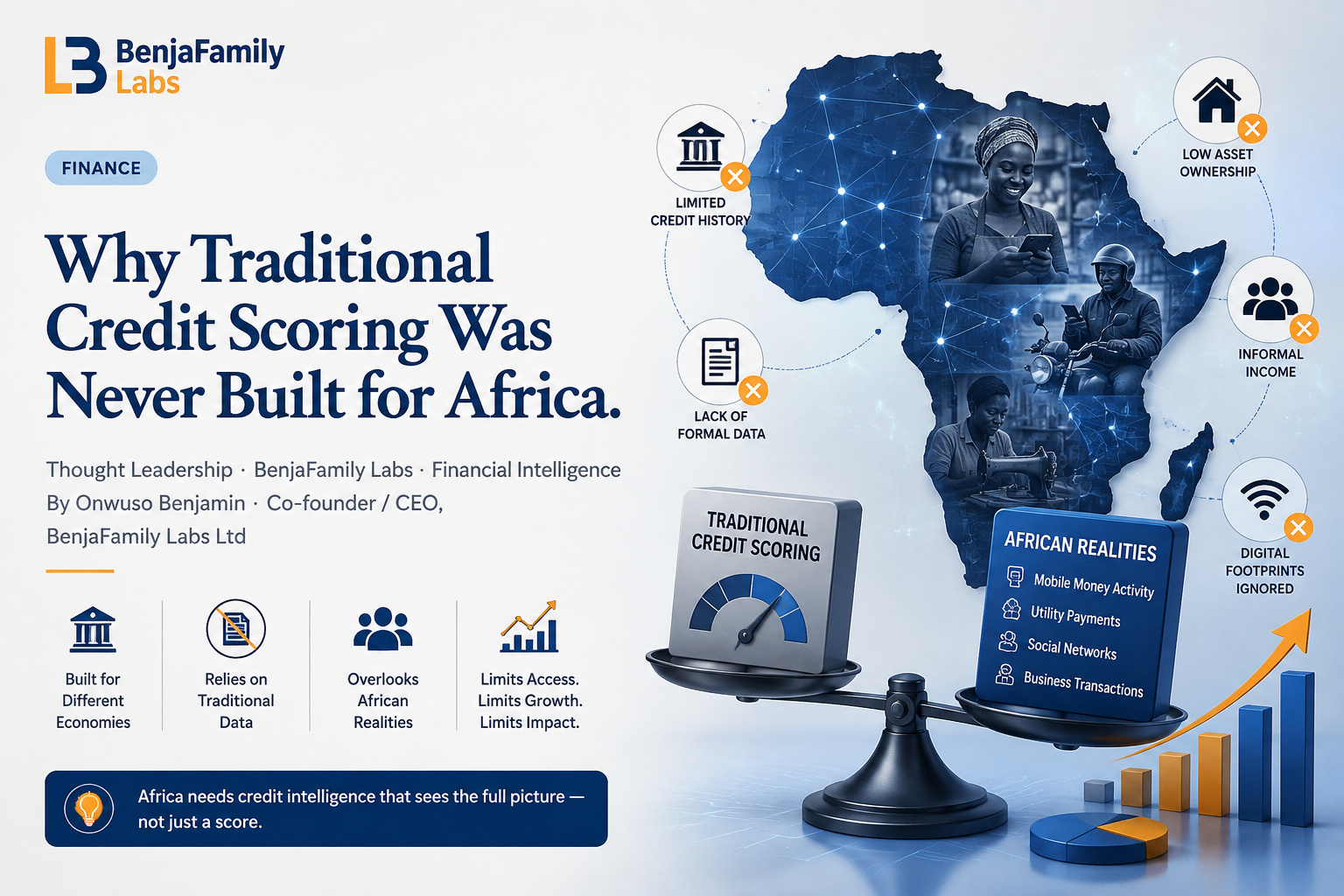
For more than three decades, traditional credit scoring has served as one of the foundations of modern lending. Models developed by institutions such as FICO transformed lending decisions by helping banks estimate the likelihood that a borrower would repay a loan.
These models have been remarkably successful in economies where they were designed to operate.
The challenge is that they were built around assumptions that do not consistently reflect the realities of many African economies.
This is not a criticism of traditional credit scoring. It is a recognition that every risk model reflects the environment in which it was created.
As Africa's financial ecosystem evolves, the question is no longer whether traditional credit scoring is useful. The question is whether it is sufficient.
Understanding Traditional Credit Scoring
Traditional credit scoring evaluates a person's likelihood of repaying debt based largely on historical borrowing behaviour. Typical inputs include:
- Previous loan repayment history
- Credit bureau records
- Outstanding debt obligations
- Credit utilization
- Length of credit history
- Types of credit accounts
- Recent credit inquiries
In mature financial markets, these variables provide meaningful signals. However, many Africans have never had the opportunity to build these histories despite demonstrating years of responsible financial behaviour. This creates a significant mismatch between available data and actual economic activity.
Structural Problem 1 Informal Economies Dominate Economic Activity Across many African countries, a substantial share of economic activity takes place outside the formal financial system. Market traders, artisans, transport operators, small retailers, farmers, and self-employed professionals generate income daily without relying on traditional payroll systems or extensive borrowing histories. Many run profitable businesses. Many support families. Many save consistently. Yet conventional credit models often struggle to evaluate them because they expect formal financial records that simply do not exist. |
The absence of traditional credit data should not automatically be interpreted as the absence of financial discipline.
Structural Problem 2 Limited Credit Histories Do Not Mean Limited Creditworthiness Traditional scoring assumes that responsible borrowing creates a reliable picture of future repayment behaviour. In many African markets, however, millions of financially responsible individuals have never taken formal loans. Some avoid borrowing entirely. Others lack access despite qualifying economically. Many first-time borrowers therefore appear "high risk" simply because the system has no historical data to analyse. |
The challenge is not poor behaviour. It is insufficient visibility.
Structural Problem 3 Cash-Based Economies Hide Valuable Financial Behaviour Cash continues to play an important role across much of Africa. Although digital payments are growing rapidly, many businesses still receive daily cash income. Traditional credit systems generally cannot observe daily business turnover, customer purchase frequency, seasonal income cycles, supplier payment consistency, or inventory movement. These activities demonstrate economic strength but often remain invisible to conventional credit models. |
Structural Problem 4 Gig Workers and Digital Entrepreneurs Do Not Fit Traditional Employment Models Africa's workforce is changing rapidly. Increasing numbers of people earn income through freelancing, ride-hailing platforms, e-commerce, content creation, remote work, digital services, and multiple income streams simultaneously. Traditional lending systems were largely designed around stable monthly salaries from single employers. Modern workers increasingly build diversified income portfolios that require different methods of risk assessment. Financial behaviour has evolved faster than many legacy scoring models. |
"The absence of a credit history is not evidence of financial irresponsibility. For millions of Africans, it is simply evidence that the system was not built with them in mind."
Structural Problem 5 Behaviour Often Predicts Risk Better Than Static Financial Records Financial responsibility is reflected not only by borrowing history but also by behaviour — paying bills consistently, maintaining stable cash flow, avoiding unusual transaction patterns, meeting supplier obligations, demonstrating predictable spending habits, and managing income responsibly over time. Behavioural signals provide dynamic insights into financial reliability. Traditional credit scores, by comparison, often focus heavily on historical debt relationships. The future of risk assessment may increasingly depend on understanding behaviour rather than relying solely on past borrowing. |
Structural Problem 6 One-Size-Fits-All Risk Models Ignore Local Context Risk is shaped by economic context. Agricultural communities experience seasonal income. Informal traders manage daily cash cycles. Small businesses operate under different liquidity constraints than salaried employees. Applying identical scoring assumptions across diverse economic environments can produce incomplete assessments. Context matters. Models designed for one financial system may require adaptation before being applied successfully in another. |
Structural Problem 7 Financial Inclusion Requires Better Data, Not Lower Standards Improving financial inclusion does not mean reducing lending standards. It means improving the quality of information available for decision-making. Financial institutions should seek more comprehensive evidence of financial responsibility rather than relying exclusively on traditional credit histories. Alternative data sources — including transaction patterns, digital payment behaviour, business cash flow, and long-term financial consistency — can complement existing credit information and support more informed lending decisions. Better information reduces uncertainty for both lenders and borrowers. |
Structural Problem 8 Africa Has an Opportunity to Build the Next Generation of Credit Intelligence Africa is not constrained by legacy infrastructure to the same extent as many mature markets. The rapid growth of digital payments, fintech innovation, mobile banking, open finance initiatives, artificial intelligence, and behavioural analytics creates an opportunity to rethink how creditworthiness is measured. Instead of replicating models developed decades ago for different economies, African financial institutions can help shape a new generation of credit intelligence — one that reflects local realities while maintaining rigorous standards for responsible lending. |
The objective is not to abandon traditional credit scoring. It is to build upon it.
A Better Path Forward
Traditional credit scoring remains one of the most important innovations in modern finance. It has improved lending efficiency, expanded access to credit, and strengthened risk management across many markets.
However, no model is universally applicable.
As African economies continue to digitize, financial institutions have an opportunity to complement traditional credit scoring with broader forms of financial intelligence that capture behavioural patterns, transaction activity, business performance, and local economic realities.
Doing so can help expand access to responsible credit while improving the accuracy of risk assessment.
"Africa does not need to reject traditional credit scoring. It needs to evolve it."
Conclusion
The future of lending on the continent will likely combine the strengths of established credit models with new sources of financial intelligence that better reflect how people earn, spend, save, invest, and build businesses.
At BenjaFamily Labs, we believe the next chapter of African finance will be defined not simply by more data, but by better intelligence. The institutions that succeed in the years ahead will not necessarily be those with the largest datasets. They will be those that can transform data into context-aware, responsible, and actionable insights that expand opportunity while managing risk effectively. Traditional credit scoring changed global finance. The next evolution may well be shaped by Africa itself. |
BenjaFamily Labs builds financial intelligence infrastructure for regulated financial institutions across Africa. The FPS API delivers AML/CFT compliance automation and alternative credit scoring purpose-built for Nigeria's CBN-regulated ecosystem.
Leave a comment
Your email address will not be published. Required fields are marked *