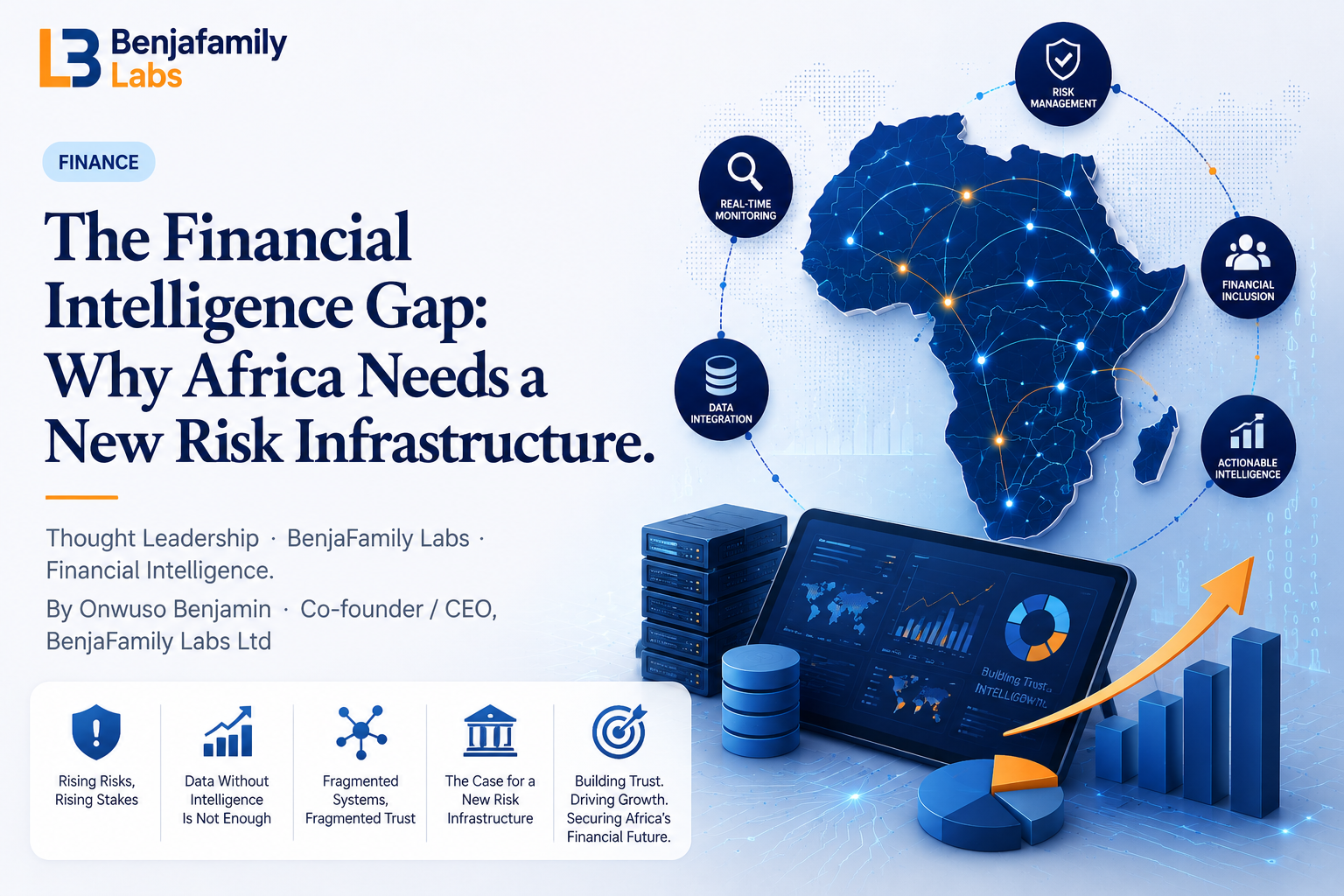
For decades, Africa's financial sector has focused on expanding access to financial services. Banks have opened more branches, fintechs have built innovative payment solutions, and mobile money has connected millions of people to the digital economy. These are significant achievements.
Yet beneath this progress lies a structural challenge that receives far less attention: Africa does not have a financial inclusion problem alone — it has a financial intelligence problem.
As financial systems become increasingly digital, the ability to understand financial behaviour in real time has become just as important as the ability to process payments. Payments move money. Financial intelligence helps institutions understand risk, detect fraud, prevent financial crime, and make informed lending decisions.
Without robust financial intelligence, growth becomes increasingly difficult to sustain.
Understanding Financial Intelligence
Financial intelligence is the ability to transform financial data into actionable insights that improve decision-making. It extends beyond traditional credit scoring. A modern financial intelligence system should help institutions answer critical questions such as:
Critical Questions Financial Intelligence Must Answer > Is this transaction consistent with a customer's normal behaviour? > Does this payment present a heightened fraud risk? > Is this customer becoming more or less financially reliable over time? > Should this transaction be investigated before it is completed? > Can this customer safely access credit despite having little or no formal credit history? |
As digital transactions continue to grow across Africa, these questions are becoming central to the future of financial services.
Structural Problem 1 Imported Risk Models Were Not Designed for African Economies Many of the risk assessment frameworks used across African financial institutions were developed for economies with mature credit bureaus, stable employment records, comprehensive tax histories, and decades of consumer lending data. Large portions of Africa operate differently. Millions of entrepreneurs earn income through informal businesses. Farmers experience seasonal cash flows. Market traders transact primarily through cash or mobile payments. Freelancers and gig workers often have multiple income sources that fluctuate throughout the year. These individuals are economically active. The result is not necessarily poor customers — it is poor visibility. |
Structural Problem 2 Traditional Credit Scoring Leaves Millions Financially Invisible Credit scores remain valuable tools where extensive borrowing histories exist. However, many Africans have never accessed formal credit despite demonstrating years of responsible financial behaviour. Someone may consistently pay suppliers, maintain regular business income, support a household, and manage cash flow effectively while remaining invisible to conventional credit systems. The challenge is no longer simply measuring past borrowing behaviour. It is developing better methods of understanding present financial behaviour. Alternative forms of financial intelligence — such as behavioural transaction patterns, payment consistency, cash flow stability, and digital financial activity — may provide a more complete picture of financial reliability. |
"The future of finance will not be defined by who owns the most data. It will be shaped by who can transform data into reliable, timely, and responsible intelligence."
Structural Problem 3 Financial Crime Has Become Faster Than Traditional Monitoring Fraud, money laundering, identity theft, account takeovers, and increasingly sophisticated cyber-enabled financial crime continue to evolve rapidly. Many institutions still depend on rule-based systems and manual reviews that identify suspicious activity after it has already occurred. This reactive approach places financial institutions under increasing pressure. |
The objective is no longer simply recording suspicious transactions. It is identifying elevated risk before significant damage occurs.
Structural Problem 4 Regulatory Expectations Continue to Increase Financial regulators across Africa are strengthening expectations around anti-money laundering (AML), counter-terrorist financing (CTF), sanctions screening, customer due diligence, and transaction monitoring. Compliance is gradually shifting from periodic reporting towards continuous monitoring supported by stronger auditability and better data governance. Institutions increasingly need systems that help them identify risk efficiently, document decisions clearly, and respond quickly to changing regulatory expectations. Technology alone does not solve compliance challenges, but better financial intelligence can significantly improve an institution's ability to meet them. |
Structural Problem 5 Data Exists, but Intelligence Is Still Missing Financial institutions now generate enormous amounts of transactional data every day. However, collecting data is not the same as understanding it. Raw transaction records become valuable only when they reveal meaningful patterns: > Emerging fraud risks > Customer behavioural changes > Unusual transaction networks > Evolving creditworthiness > Operational vulnerabilities |
The future of finance will not be defined by who owns the most data. It will be shaped by who can transform data into reliable, timely, and responsible intelligence.
Closing the Financial Intelligence Gap
Africa's financial sector stands at an important moment. The continent's rapid adoption of digital payments, mobile banking, fintech innovation, and digital identity systems creates an opportunity to rethink how financial risk is understood.
Closing the financial intelligence gap will require collaboration between regulators, financial institutions, technology companies, researchers, and policymakers.
The goal is not to replace existing financial systems, but to strengthen them with more adaptive, context-aware, and data-driven intelligence that reflects the realities of African economies.
Looking Ahead
At BenjaFamily Labs, we believe the future of financial services extends beyond processing transactions. It lies in understanding them.
Our research focuses on how financial intelligence can help institutions improve risk assessment, strengthen fraud detection, support responsible lending, enhance compliance capabilities, and contribute to greater financial inclusion across Africa.
As financial ecosystems continue to evolve, developing stronger financial intelligence may become one of the continent's most important opportunities — not only for financial institutions, but for the millions of individuals and businesses whose economic potential remains difficult to measure using conventional approaches.
The conversation about Africa's financial future should not be limited to expanding access. It should also focus on building the intelligence infrastructure required to support a safer, more inclusive, and more resilient financial system.
BenjaFamily Labs builds financial intelligence infrastructure for regulated financial institutions across Africa. The FPS API delivers AML/CFT compliance automation and alternative credit scoring purpose-built for Nigeria's CBN-regulated ecosystem.
Leave a comment
Your email address will not be published. Required fields are marked *