
Onwuso Benjamin · Co-founder / CEO, Benjafamily Labs LTD. 10 min read
~60% Adults outside formal credit in Africa | 65–75% Digitally active via mobile money |
10–15% SMEs with reliable credit histories | ∞ Untapped behavioural data footprint |
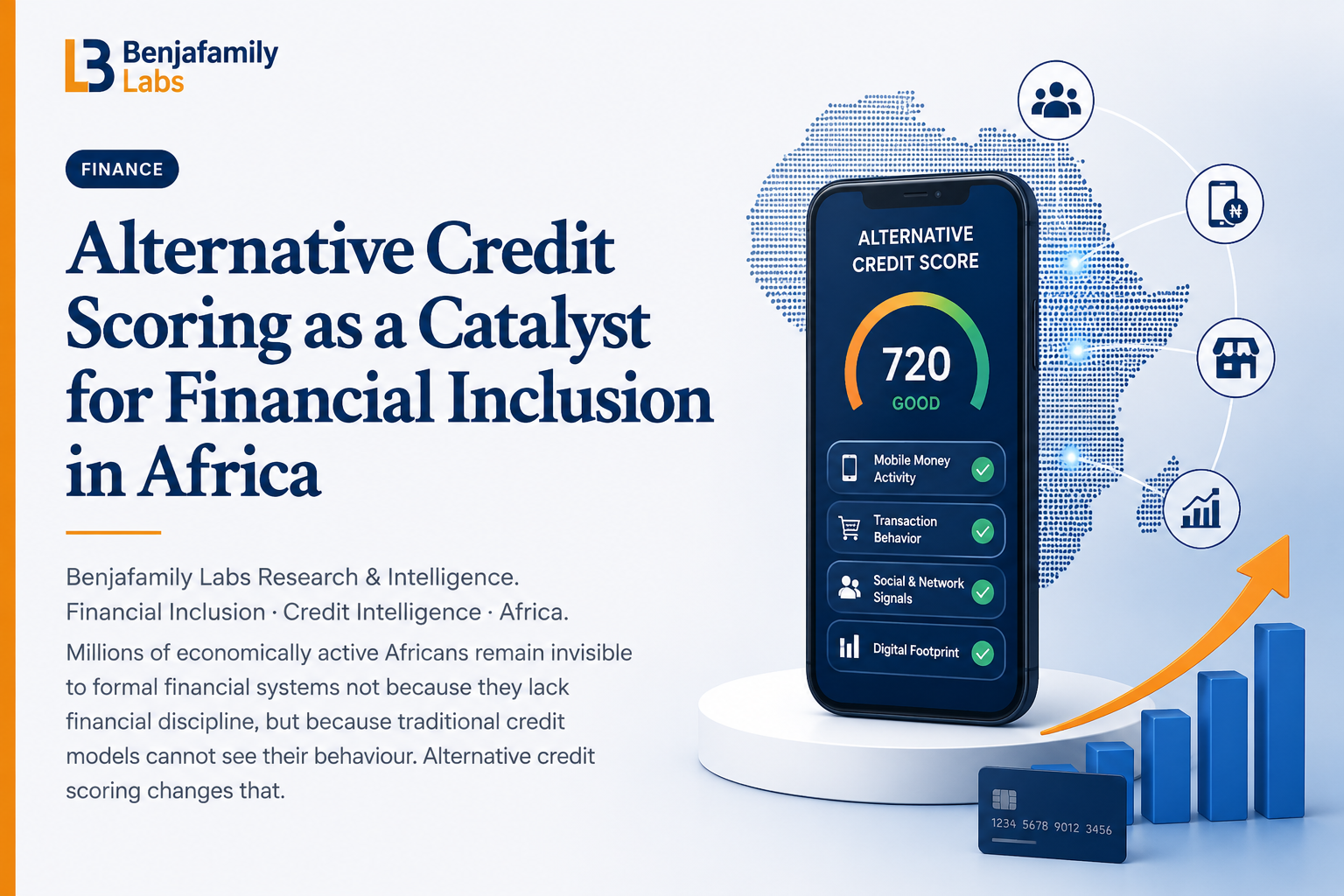
Africa possesses one of the most underbanked yet economically active populations in the world. Across the continent, millions of individuals and small businesses remain excluded from formal financial systems despite participating daily in economic activity through mobile money, informal trade, digital commerce, and social financial networks. Traditional banking institutions often fail to recognise these populations as creditworthy because conventional credit scoring models depend heavily on collateral, formal banking history, salary records, and centralised credit bureau data.
This structural limitation has created a financial paradox: economically active citizens exist outside the formal credit ecosystem despite generating measurable financial behaviour every single day. Alternative credit scoring presents a transformative solution. By leveraging behavioural analytics, transaction intelligence, mobile money activity, telecommunications metadata, digital commerce behaviour, utility payment history, and artificial intelligence, alternative scoring systems can create financial identities for populations previously considered "invisible" by traditional banks.
In Africa's emerging digital economy, alternative credit scoring is not merely a fintech innovation — it is foundational infrastructure for financial inclusion, economic growth, SME expansion, and intelligent regulatory compliance.
Understanding Alternative Credit Scoring
Alternative credit scoring refers to the use of non-traditional financial and behavioural data to evaluate an individual's or business's creditworthiness. Unlike traditional credit systems that rely primarily on bank statements, payroll records, existing loans, credit bureau histories, and physical collateral, alternative models incorporate a far richer and more accessible dataset.
| Traditional Credit Model | Alternative Credit Model |
|---|---|
| Bank statements | Mobile money transactions |
| Payroll records | Airtime recharge frequency |
| Existing loans | Utility bill payments |
| Credit bureau histories | Digital wallet activity |
| Physical collateral | E-commerce behaviour |
| Slow approval process | Transaction velocity & real-time scoring |
| Urban-centred access | Device consistency & geolocation patterns |
| High exclusion rate | Savings patterns & behavioural repayment intelligence |
This allows fintech systems to generate dynamic financial trust scores for users with limited or nonexistent banking histories — assessing a far broader range of signals to produce more accurate, inclusive, and real-time risk assessments.
The African Financial Inclusion Problem
Africa's financial ecosystem faces several long-standing structural barriers. Traditional financial institutions interpret missing financial history as high risk — when in reality the problem is almost always data invisibility, not financial irresponsibility.
| Structural Challenge | Financial Impact |
|---|---|
| Large unbanked population | Limited access to loans and formal finance |
| Informal economies | Lack of traceable financial records |
| Weak credit bureau coverage | Insufficient borrower data for lenders |
| High collateral requirements | SME exclusion from working capital |
| Rural banking limitations | Geographic financial inequality |
| Identity fragmentation | Weak KYC verification and reduced credit issuance |
| High lending risk perception | Reduced credit issuance to viable borrowers |
Africa's Financial Inclusion Gap
The digital behaviour footprint in Africa is significantly larger than the formal banking footprint. This creates a massive opportunity for transaction intelligence systems.
Mobile Money as Financial Identity Infrastructure
The rise of mobile money platforms across Africa has unintentionally created one of the largest alternative financial datasets in the world. Even without bank accounts, users on these platforms generate rich behavioural data — payment frequency, cash flow patterns, merchant interactions, remittance activity, savings behaviour, and transaction reliability signals. These datasets can be transformed into predictive credit intelligence models.
Each of these platforms has become a behavioural financial infrastructure in its own right — generating the raw intelligence that alternative credit systems need to function at scale.
The Analytical Framework: Four Core Intelligence Layers
A robust alternative credit scoring engine is built on four compounding layers of financial intelligence, each feeding into the next to produce a dynamic, real-time credit decision.
- Spending consistency
- Cash inflow patterns
- Merchant diversity
- Repayment probability
- Income volatility signals
- Financial discipline
- Device consistency
- Usage patterns
- Fraud indicators
- Behavioural trust scores
- KYC verification
- AML screening
- FATF compliance
- Risk categorisation
- Fraud detection
- Machine learning
- Risk prediction models
- Adaptive scoring
- Dynamic thresholds
- Portfolio intelligence
How the Intelligence Engine Works
Why Alternative Credit Scoring Matters for Africa
Expanding SME Financing
- Daily transaction volume
- Supplier relationships
- Merchant reliability
- Inventory turnover
- Revenue consistency
Digital Lending at Scale
- Instant loan approvals
- Microcredit issuance
- Embedded finance
- Buy-now-pay-later systems
- Cross-border fintech lending
Strengthening Inclusion
- Market traders
- Gig workers & farmers
- Youth entrepreneurs
- Women-led businesses
- Rural populations
Financial inclusion becomes behaviour-driven rather than documentation-driven. This is the fundamental shift alternative credit scoring enables — and it changes who gets access to capital across the entire continent.
The Role of Financial Intelligence APIs
The next evolution of Africa's fintech infrastructure is the emergence of Financial Intelligence APIs — programmable systems that integrate multiple intelligence capabilities into a single accessible layer. Instead of building isolated fintech tools, startups and institutions can create programmable intelligence infrastructure for banks, lenders, fintechs, regulators, and SMEs.
This transforms alternative scoring from a lending feature into a broader financial governance infrastructure — one that serves not just lenders but regulators, compliance teams, and the entire ecosystem.
Alternative Credit Scoring and Regulatory Technology
Regulators across Africa increasingly require transaction transparency, AML monitoring, risk profiling, suspicious activity detection, and consumer protection mechanisms. Alternative scoring systems integrated with compliance intelligence directly address these requirements.
Regulatory Requirements
- Transaction transparency
- AML monitoring
- Risk profiling
- Suspicious activity detection
- Consumer protection mechanisms
What Compliance APIs Can Support
- CBN compliance automation
- FATF-aligned risk systems
- Anti-fraud infrastructure
- Digital identity verification
This transforms alternative scoring from a lending tool into a pillar of the broader regulatory technology ecosystem — making compliance and inclusion reinforcing, not competing, priorities.
Key Risks and Challenges
Despite its potential, alternative credit scoring also introduces serious concerns that must be addressed for the technology to achieve sustainable impact.
Responsible AI and Ethical Financial Intelligence
To build sustainable inclusion systems, African fintech ecosystems must ensure that the pursuit of financial inclusion does not evolve into digital financial surveillance. Responsible development requires deliberate commitment to the following principles:
The Strategic Opportunity for Africa
Africa has a unique opportunity to leapfrog legacy banking systems entirely. Rather than replicating Western credit infrastructure, African fintech ecosystems can build something more powerful, more inclusive, and more native to the continent's digital reality.
Conclusion
Alternative credit scoring represents one of the most powerful tools for expanding financial inclusion across Africa. By transforming digital behaviour into financial trust infrastructure, fintech systems can unlock credit access for millions previously excluded from formal banking systems.
The future of African finance will increasingly depend on intelligent infrastructure capable of combining:
- Transaction intelligence
- Behavioural analytics
- Compliance automation
- AI-driven risk modelling
- Mobile financial ecosystems
As financial intelligence APIs evolve, alternative credit scoring may become the foundational layer powering Africa's next generation of digital banks, embedded finance platforms, SME lending systems, and regulatory technology infrastructure.
"The challenge ahead is not whether Africa can build these systems — but whether it can build them responsibly, securely, and inclusively. If successful, alternative credit scoring could become one of the continent's most important economic inclusion technologies of the 21st century.

Leave a comment
Your email address will not be published. Required fields are marked *